
"When We Have Built It"
How LDS fathers can raise children in light of modern challenges


Every parent eventually asks “Where did the years go? Wasn’t it just yesterday when all my children were small?”
Asking this is as sure a sign as any that they’re about to join the club of older parents and empty-nesters who say to younger parents, those still neck deep in sleep deprivation and diapers, “Enjoy it! Someday you’ll miss it.”
At present, I’m caught between those two feelings. My oldest children are tweens and teens. My youngest is learning to crawl. And yet, still… where did the years go? Wasn’t it yesterday that all my children were small? How is it that I already know today that someday in the future I will indeed miss this?
This nostalgia, even as I’m still changing diapers and getting less than ideal amounts of sleep, reminds me that the wonder, magic and beauty of childhood is brief. A flash and it’s gone. A few short years which give way to the pressures of adolescence and adulthood. And poof, the child is gone and then they are what they already became.
You will know your children as adults far, far longer than you know them as children. So we should keep in mind that we aren’t raising children; we’re raising future adults, parents, church leaders, neighbors, ministers, providers, homemakers and inheritors of our present-day actions and patterns.
Perhaps that’s an obvious statement, but the truth of it still comes to us as a surprise because we are so intent on keeping our children as children, doing childish things for as long as possible. In the past, most cultures, including our own, understood the brevity of childhood, the inescapable encounter with maturity, and then planned accordingly.
They saw individual families not as sovereign entities, working out everything on their own, but as so many links in a chain carrying us all the way back to God. That view has been hijacked by what we now call the “nuclear family”:
We have witnessed the transformation of the extended kin-group into a completely new phenomenon called the isolated nuclear family… It is what we see driving around with suitcases on the roof rack and sharing a table for four in the hamburger joint. That hallowed unit – mum, dad, kids – is no longer part of a wider whole. It is a social quark, a subatomic particle that manifests in courtship, whizzes through marriage and child-rearing, and dissolves in divorce or old age. It comes together, divides, and vanishes. 1
One reason why we must defend the family so vehemently in our day is because most of its natural defenses: community, extended family, kin, local culture, thick church culture have been obliterated. The nuclear family is where we make our literal last stand.
Home Centered
In recent years, the Church has shifted more responsibility onto the family in the form of several initiatives we could refer to as “home-centered, church-supported”. Church leadership has shortened church to encourage home study, ideally done with multiple families; they’ve localized youth programs to benefit the youth on the ground rather than adhering to a standardized approach across the world; they’ve even pulled back on blanket enforcement of a few specific standards in order to create an opportunity for those standards to be taught and bought into within the home.
Far too many have interpreted these moves as the church “not caring” or asking less of us. But in reality it’s asking more of us than ever.
We can’t outsource everything to the structure of the church anymore. It’s incumbent upon us to do the heavy lifting within our own homes and relationships. I’m reminded of two prophetic quotes. One more recent and one a little older. First from President Nelson:
In coming days, it will not be possible to survive spiritually without the guiding, directing, comforting, and constant influence of the Holy Ghost.
And one from Brigham Young:
If ever we are to walk in streets paved with gold, we will have to go to work and get the gold out of the mountains to lay down…. when we have streets paved with gold, we will have placed it there ourselves. When we enjoy a Zion in its beauty and glory, it will be when we have built it. If we enjoy the Zion we now anticipate, it will be after we redeem and prepare it… If we do not as individuals complete that work, we shall lay the foundation for our children and our children’s children, as Adam has.
From my point of view, the church has made it abundantly clear in the last decade that checking the boxes of church activity and involvement is not going to be sufficient to “produce the faith necessary unto life and salvation.”2 It might have been when the church was Utah and Utah was the church, but that time is gone. It seems to me the church, since Brigham Young at least, has been asking us to “go and get the gold”, go and make it happen.
The Current State of the Family
While Latter-day Saints enjoy more family success than the average American, we are by no means immune to what is happening to the broader American family, and to other churches—more like we’re just late to the party.
Best guess is that our birth rate is only slightly above replacement. There’s no public data on youth retention, but perhaps we hold onto half of our youth. Again, better than our “gentile” or irreligious peers, but far from the growth and strength we once experienced in the recent past. And perhaps more importantly, far from the hopes and dreams of many parents and those wishing to be parents.
The nature of these challenges are unique to our time. We don’t face persecution like the early Saints did. We don’t face generations of slavery like the children of Israel endured. We don’t have the Lamanites just down the road constantly threatening to exterminate us. But what we do face is a strong and alluring anti-family culture; a culture that has slowly, but successfully disrupted the continuation of family tradition and identity from one generation to another.
Many bloodlines have already fallen and many more stand to fall unless we are willing to meet this challenge head on with a set of new tactics.3 As my friend Marcellino D'Ambrosio recently observed:
The most radical, most distinct, and least assimilated groups are the most successful at promulgating their beliefs. For Christians, this should be instructive. The more your faith looks like the secular world, the less likely it is to win the formation war. Sadly, most Christian faiths are pursuing precisely the opposite strategy. They attempt to make themselves more and more “relevant” to mass culture. This might be an effective strategy if all that made a Christian was weekly church attendance and self-reported identification; however, since that is NOT what makes a Christian, this strategy is DOA.
This warning is coming from those who are further along the assimilation pipeline than we Latter-day Saints are. They’re honking their horns at us, flickering their headlights. “Dead-end ahead! Turn around!”
In my view, the church is asking us as Fathers in the 21st century to respond to this challenge in a home-centered way. There is no roadmap for the solution and each of us must go to God in prayer and seek revelation on the best path forward for our families and communities but here are some principles that I think are helpful.
Russel M. Nelson is a Prophet of God, but to your children you are “The Church”
A few months ago I wrote an article called “What Does My Son See?” In it I shared the following anecdote about a Priesthood gathering:
I was in a large room with many men and many teenage boys. I looked around the room at the men: good men, loving men, kind men, men who were sacrificing their time to be here with these boys. But also out of shape men, tired men, men distracted by devices, men who have a hard time understanding boys today, men who feel life has passed them by, men whose primary skill is only useful deep within the bowels of a corporate org chart and whose primary hobby is either a 40 year old movie franchise or a sports team. Boys themselves once, but men now with some long forgotten ambition.
Then I looked at the boys, many of whom were our sons. I thought: “We are their dads and church leaders. They love us, but do they want to BE us?” I would understand why if they didn’t.
A personal conversion to the Gospel of Jesus Christ is key to life-long discipleship and covenant making. Nothing can replace that and it will only happen when a young man or woman makes the choice to seek that relationship with God. But we are very social creatures and it helps to have examples of why making that choice is good and why the identity and meaning which comes from that choice is empowering. Especially when there is a competing anti-family culture sitting right there, promising everything and asking for nothing.
Show, not just tell. Tired, overwhelmed, overworked and overweight men, doodling on their iPads while listening to another talk about ministering will be enough to help facilitate the personal conversion of some of the children we raise. After all, we are still living and preaching The Truth and the Spirit of the Lord is real4.
But for many others, they will be helped by seeing aspirational examples of Christ-like masculinity up close and personal. Those examples can only come from you and the other men at church. It’s only good if young people see that the men in their lives love being fathers and husbands, that they’re striving for improvement—that their lives, entertained tightly with their faith, bring immense joy. Prophets, Apostles and Seventies are too far away to fulfill this role. Theirs is a farseeing “watchtower” role, to keep us going in the right direction; not hand hold us through every decision and step along the way. As President Oaks once said of his role as an Apostle:
As a general authority, it is my responsibility to preach general principles. When I do, I don’t try to define all the exceptions… [And] don’t ask me to give an opinion on your exception. I only teach the general rules. Whether an exception applies to you is your responsibility. You must work that out individually between you and the Lord.5
But have no fear, the church has already given us the *general* template for aspirational adulthood AND encouraged our youth to follow it. This is of course the four goal areas of the Youth Program: physical, spiritual, intellectual and social.6 Every man, no matter his age, can seek development in these four areas in an effort to offer a continually aspirational, rewarding, challenging and coherent picture of righteous fatherhood, manhood, and masculinity to his children and to the children in his ward and stake.
You can just do it. There’s nothing stopping you. Certainly not the church.
Other Parents Are Your Secret Weapon
We don’t have to fight this anti-family culture alone. The other parents in our ward and stake can be our closest allies and our children’s most staunch supporters. Remember, the church has withdrawn some structure in part so we can fill it with more locally meaningful and organic associations7: i.e. that means fewer church, templated and planned activities and more YOU planned and curated activities.
But instead of rolling up their sleeves and getting to work on their church community, many have taken this opportunity to dig themselves and their families further into isolated corners, partaking freely of their favorite parts of our anti-family culture by filling their time with things, activities, practices, clubs, teams and interests which others cannot be a part of because they have their own favorite things to do.
Every family becomes an island.
But here’s an except from the Church’s General Handbook on the responsibility of Ministering Brothers and Sisters, which we are all called to be:
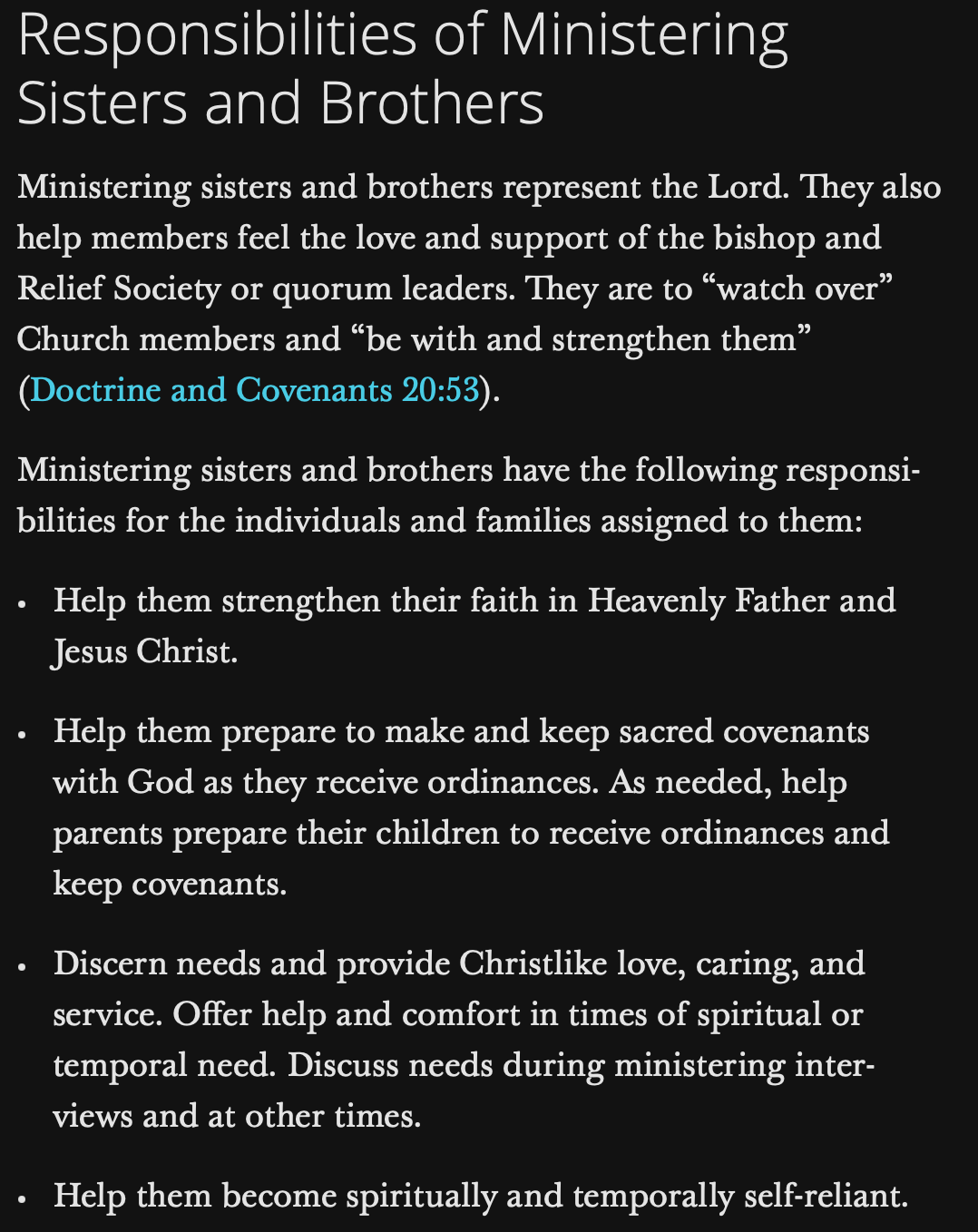
Wow, aren’t those things supposed to be, like private, or something? Isn’t that stuff just the responsibility of the Bishop? This makes it sound like I’m supposed to be really involved in the lives of the people in my ward. And they in mine, in some sort of…. community??? I thought Christianity was maintaining a loving, but comfortable distance from everyone???
It’s my personal belief that we can expect a lot more from our fellow parents than we currently ask. That we can work together to:
create common rules and standards that will help the youth we have stewardship over conquer the challenges of their day—grow, stretch themselves, mature and prepare to be adults.
be less defensive about our own parenting and seek out other parents who are strong where we are weak.
experience the full life of a disciple—including dealing with people issues, disagreements, conflict; as well as mercy, forgiveness, and patience.
create “rites of passage” or local rituals8 which give our kids a coherent community to roam around in.
The Church is not about to release a new global program which will magically help you get closer to other parents. We will have to go up to the mountain and get the gold there ourselves.
Apathy Is Your Greatest Enemy
Perhaps the key lesson from “The Screwtape Letters” is that the adversary is willing to take any form necessary to put distance between us and God. We grow up hearing and learning to resist one version of Satan’s lies only for our kids to hear a completely different set.
As Elder Neal A. Maxwell once said:
The Kingdom of the Devil must be regarded as a collective, generic designation. We must not confuse it with any of its subsets, as ominous and bad as they may be for their season in human history. We must not confuse the subsets with the whole of it.
Perhaps one of the subsets we deal with now in the 2020s, as fathers who are trying to raise righteous children, is apathy. Both amongst ourselves and our kids.
In parents it manifests as not wanting to encroach upon our kid’s choices. This hands off, “be a friend to my kid”, apathetic approach to parenting is our enemy. For example, I’ve observed many parents are OK giving practical advice, like “get good grades and go to college”, but are less comfortable with giving directions and guidance on how to date and marry. This can come from a lack of confidence and skills, or a lack of ever being told *how* to do this themselves. But no matter the cause, there’s no doubt this is exactly the approach our anti-family culture would like us to take.
Regarding youth, for a long while there, the stereotype was of youth rebellion and sin. Youth were doing worse things all the time at ever earlier ages. I’m sure this still describes some cases, but in my experience, this doesn't convey the broader issue anymore. Maybe it’s technology and smartphones? Maybe something else? Dunno, but it’s more like youth leave because they’ve filled their lives with other things and identify most strongly with immature forms of being—forms which aren’t really compatible with family life, nor a lifetime of Christian discipleship.
They’re not rebelling, they’re just totally apathetic, the church and its teachings are totally irrelevant. This is the fruit of the modern approach to childhood: that it should last as long as possible and adult responsibilities are actually not that interesting or empowering.
The biggest thing standing between us and that “gold in the mountains” is apathy. No matter our callings, no matter our ward and stakes, we can do our part to break through that apathy and work with other parents to create real life, in the flesh, up close and personal examples of Christian men for the children in our stewardship to see. And how glorious it truly is. For us and them.
Enduring To The End
A third of the host of heaven fell away. Many generations of Israel fell to iniquity. Two of Lehi’s sons rebelled against him. Many of the apostles ordained in 1830 apostatized. In a way, what we face is nothing new, even as it looks entirely different.
The basic path of faith in Christ, repentance, and the Holy Ghost are the same as they ever were. But enduring to the end… well I think what that looks like changes a little based on our generation and the unique challenges each faces. There were challenges unique to Kirtland, Independence, Nauvoo, in frontier Utah, or in 1950s Utah or in 1990s Texas where I grew up. Enduring to the end meant being faithful to the same gospel in different contexts.
Our time is no different. And in a global church, there can be many sets of unique challenges playing out all at once.
But I’m of the belief that for average LDS dads, doing what we can to give our kids this kind of “home-centered” consistency in a fragmented and chaotic world is likely our best shot at breaking through their apathy; they’ll feel the drive to seek out the Tree of Life (Christ) because the fruit they can see, from their own fathers, uncles, and church leaders, is so sweet.
Written by Michael Schluter, in his 1991 book “The R Factor”.
From “Lectures on Faith”
We should always be aware of survivorship bias: thinking that what helped us be who we are today, that is an active father in The Church of Jesus Christ of Latter-day Saints”, is what will help our children. Remember, many of our peers had exactly what we had and they didn’t make it.
Some will not choose to continue in the Church no matter what we do. But I think we should do what is within our power to do.
From a BYU Devotional he gave in 2005 titled “The Dedication of a Lifetime.” An address also memorable for his not so subtle encouragement for BYU students to get a move on and date and marry.
Itself patterned off Luke’s description of Christ’s growth and development found in Luke 2:52: “And Jesus increased in wisdom and stature and in favor of God and man.”
Not just for longer Sunday naps.
I’m not talking about heathen rituals or new apostate ordinances or something. It could be literally anything locally meaningful that helps youth mark, prove and celebrate their transition from childhood to adulthood.
 | A guest post by
|
"Russel M. Nelson is a Prophet of God, but to your children you are “The Church”." Great line. I will burn this into my memory.